Linux Air Combat
A downloadable game for Linux
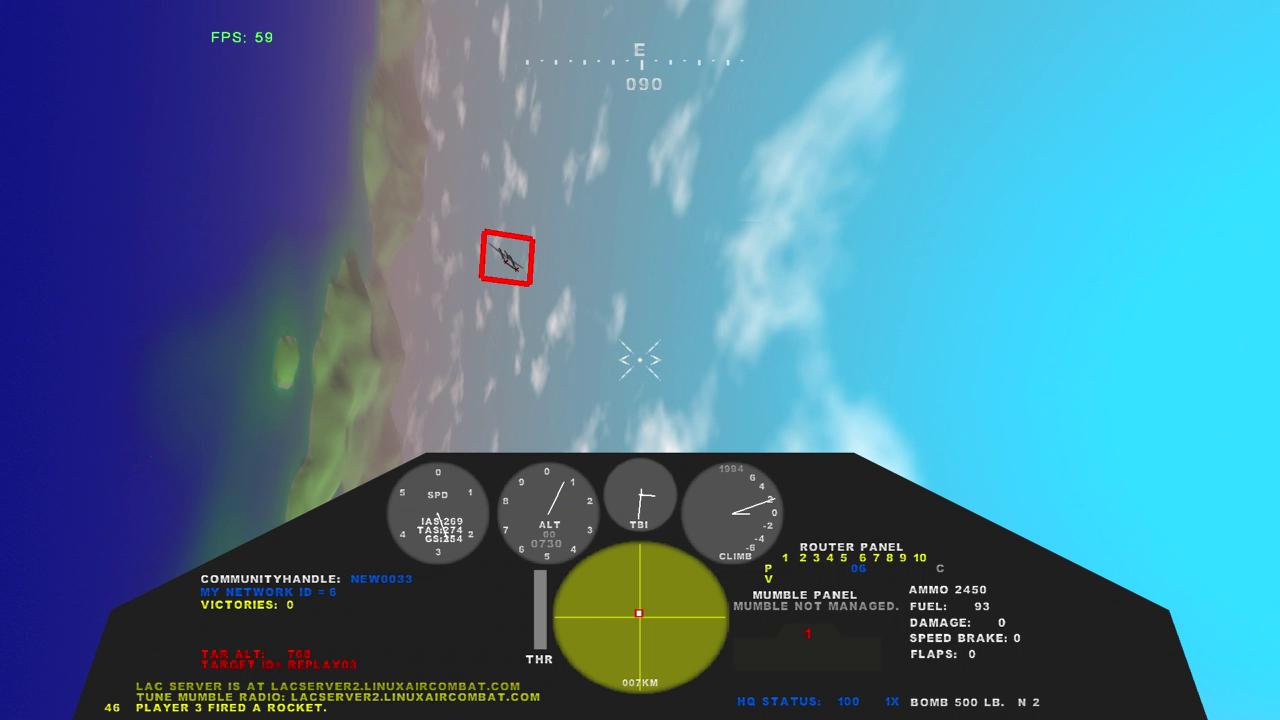
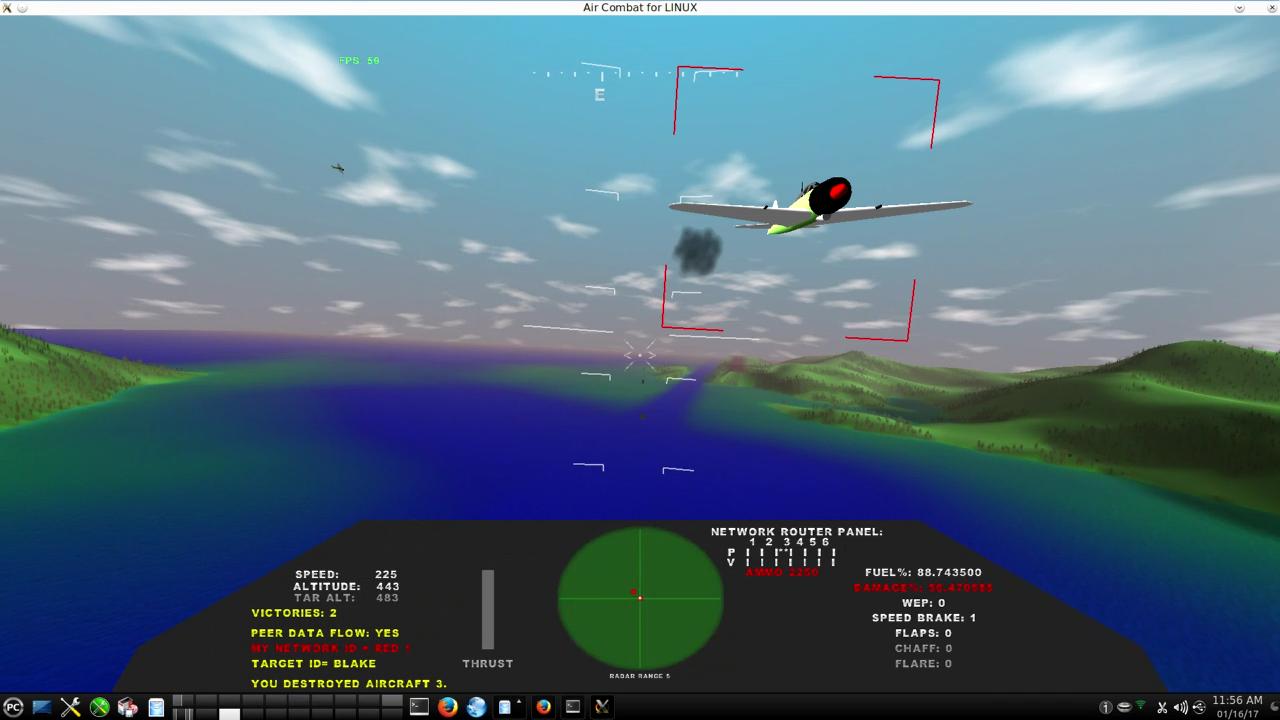
LINUX AIR COMBAT is a free, open-source combat flight simulator for the LINUX community. Its roots came from the well-known "classic" flight game "GL-117", but this new incarnation has been extensively re-written and improved. This is now the world's leading open-source combat flight simulator for Linux.
LINUX Air Combat is also known as "LAC".
This page includes several YouTube video clips and PlayLists, so you can see exactly what it's like.
This is NATIVE LINUX code, so you don't need wine, or proton, or steam, or anything else.... just download and run! The itch.io download is a precompiled, prelinked AppImage for any popular desktop LINUX distro running on industry standard "X86" hardware, so you don't need to compile from the published source code (and if you've optimized your LINUX system, expect a smoother experience with higher frame rates than you're accustomed to seeing on Microsoft Windows)!
IMPORTANT NOTE: On some modern desktop LINUX platforms, LAC's menu buttons do not respond to mouse clicks. We've solved this problem with our optional "LacMenuLauncher" utility. CLICK HERE to learn how to get and use it.
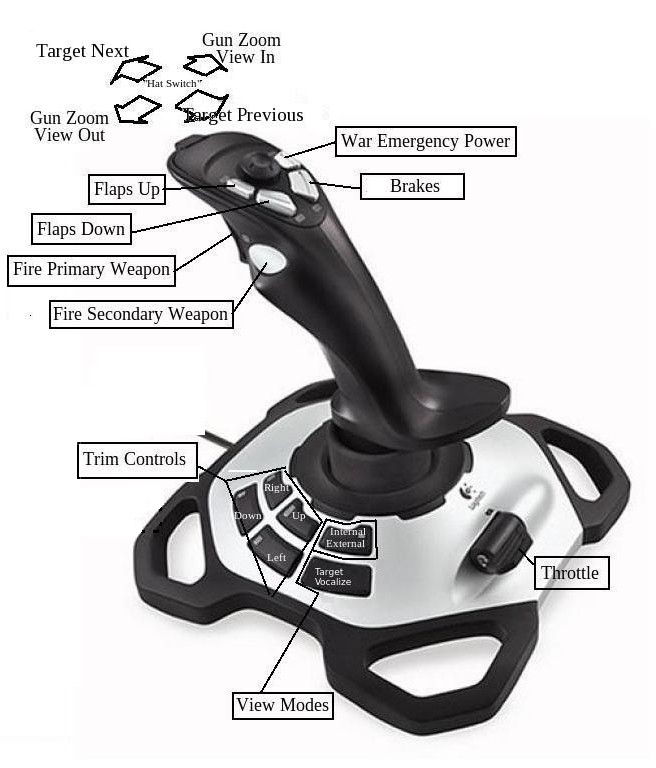
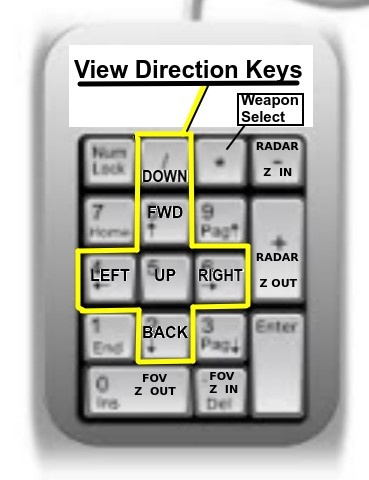
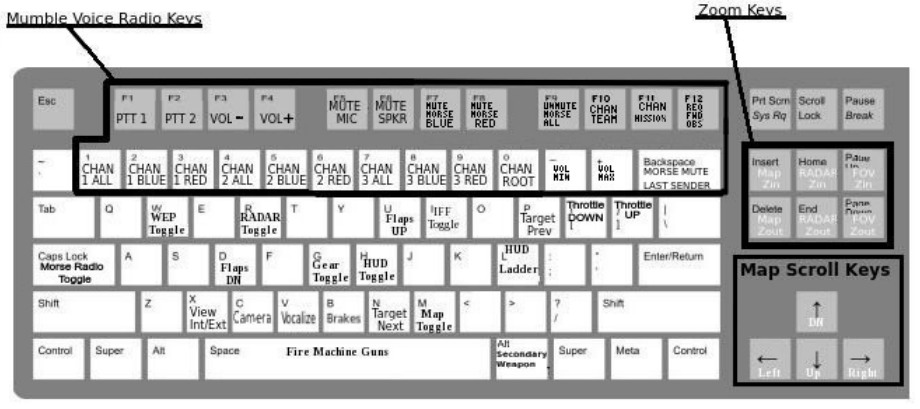
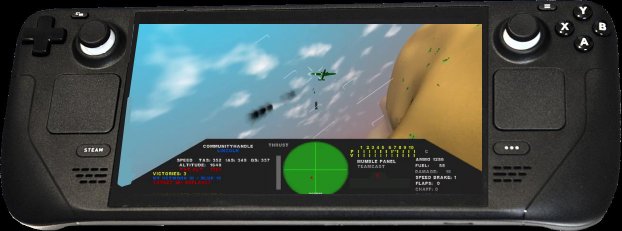
Joystick and Keypad Controls. (Or just fly with your keyboard and mouse). If you don't have a joystick, use the "[" and "]" keys to control your throttle. Alternatively, you can use a console-style Game Controller like that shown below

https://askmisterwizard.com/2019/LinuxAirCombat/Planes/01.htm
Through that link you can examine each aircraft, one-by-one, from those pages, which are organized alphabetically by country, manufacturer, and aircraft name. Each plane gets its own page with a tabular summary and at least two YouTube documentary video clips. Links in each page lead to the next plane in the sequence, or to the prior one. These pages are also available within LAC, as if you were in a warbirds museum where you can study and choose among all of the displayed aircraft, then open the cockpit of your favorite, climb in, taxi out onto the runway, and fly it solo, against offline opponents, or online with others!
Now available for free Internet download, this high-performance flight simulator supports all of the basics demanded by today's LINUX flight sim users, including all of these features:
- Free and open source distribution. The clean source code compiles without modification on major LINUX distros.
- A precompiled binary executable is available in a single, self-extracting volume containing all required prerequisites, eliminating any need to compile. This is compatible with almost all popular desktop LINUX distros using industry-standard "x86" hardware.
- Very smooth, simple, high-performance graphics yield high frame rates even on modest computer hardware.
- 45 flight/view functions can be mapped to any detected joystick axis, button, or keyboard key.
- Modern, multi-axis analog/digital joysticks or console-style "Game Controllers" support precision control of elevators, ailerons, rudder, throttle, etc.
- Mouse control of elevators, ailerons, and weapons for those lacking a joystick.
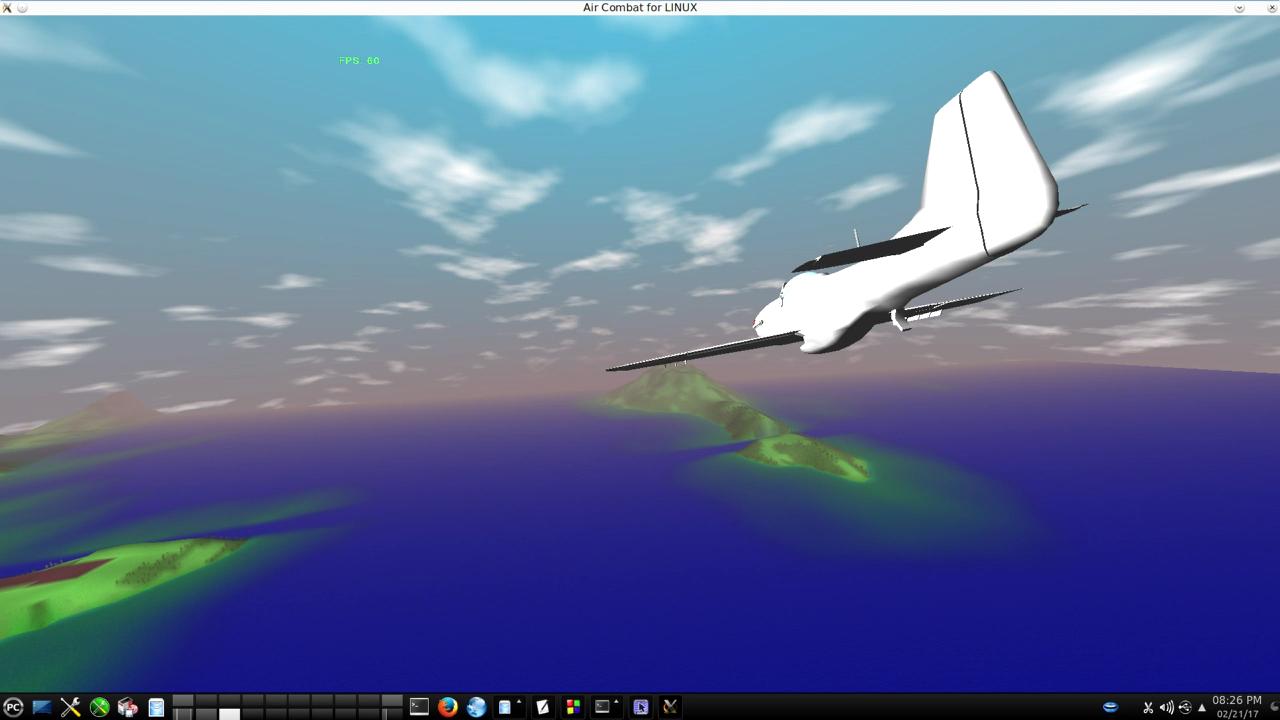
- 54 different flyable aircraft from World War II.
- A theoretical Jet fighter with performance similar to the Douglas A4 SkyHawk.
- Industry-standard "Air Warrior" style view system is easily configurable for other view options.
- Sophisticated flight model with low-speed stalls, accelerated stalls, compressibility, blackouts, redouts, torque rolls, induced turbulence, and low-speed control fade.
- Realistic high-altitude degradation of engine performance.
- Fuel consumption is proportional to engine load including WEP/Afterburner effects.
- Flight performance is degraded when lugging heavy bombs or rockets.
- Flight performance is degraded when aircraft are damaged.
- Simulated RADAR to help locate opponents.
- Enemy airfields and RADAR facilities can be damaged or destroyed.
- Simulated IFF to help Identify Friend versus Foe.
- Guns combat.
- WW2-era Air-to-Ground rockets.
- WW2-era bombs.
- Free flight mission.
- Four tutorial missions with detailed audio narration to help beginners get a quick start.
- Online "Head to Head" mission suitable for air racing or combat (2 players only. No server required.)
- Free, high performance Linux Air Combat Server is now available at LinuxAirCombat.com.
- Ten distinct, ten-player Internet missions in various terrains, with strategic airfield combat (Internet and access to a free LAC Server required).
- Additional multi-player missions are added from time to time.
- Users can record "GunCamera films" and ask the Server to replay them as persistent "Server Missions".
- 32 distinct, online Realms, each supporting unique missions and/or communities.
- Realm "1" constantly runs persistent Server "Strike" missions that the player can join or oppose (and other online users might join at any time!).
- User-loadable graphic aircraft models support the free, open, well-known ".3ds" format.
- User-loadable background music, sound effects, and narration files support industry-standard ".wav" format.
- "Talking Cockpit" can verbalize target location so you can hear it without diverting your eyes.
- Innovative "Network Router Panel" on cockpit shows network telemetry and comms data flow from other players.
- Best-of-breed network user management with inter-player status messages on the cockpit panel.
- Powerful integration with "Mumble" for world-class voice communication between players.
- Dedicated Mumble server manages a rich hierarchy of voice radio channels and online help.
- Custom-coded mumble interface supports "Push-To-Talk" even in "Wayland" environments where "Push-To-Talk" is usually impossible.
- Built-in "Mumble Panel"cockpit instruments constantly reveal all mumble talking, receiving, and channel-changing activity with no need for "helper"utilities or monitoring or managing mumble outside of LAC.
- Mumble functions can be mapped to joystick buttons or keyboard keys with no need to configure any "shortcuts" within mumble.
- Automated radio messages verbalize enemy airfield status.
- 23 Comms-related functions can be mapped to any keyboard key.
- Text-only, low-bandwidth comms option acts like a "Morse Code" radio, generating and decoding real Morse code.
- Airfields with defensive guns challenge nearby opponents and protect nearby allied aircraft.
- Airfield defenses can be damaged and degraded with bombs, rockets, and/or machine guns.
- Damaged airfield defenses are gradually repaired by surviving airfield maintenance personnel.
- Air raid sirens blare loud on damaged airfields.
- Bombers have auto-gunners that take shots at nearby hostile fighters.
- "Norden" bombsight emulation makes precision, medium or high altitude bombing possible.
- Realistic bomber climb rates: Heavily loaded bombers need a long time to climb to altitudes high enough to avoid fighters.
- Realistic bomb-run tactics make heavy bombers vulnerable to opposing fighters during critical mission segments.
- Real-time, automated radio and RADAR warnings alert players when their airfields are threatened by strategic bombers.
- Online users can choose their own unique "CommunityHandle" name, and see the names of other players.
- Online player list constantly advertises the names of players in flight and the missions in which they are active.
- Log file stored on the player's computer keeps a detailed history of all online victories.
- Supported by an active development team for bug fixes.
- Extensively documented on YouTube.
LAC is intended as an ONLINE combat flight sim, so the best LAC experience is enjoyed when you are flying with others. However, the LAC community is SMALL Often you will find that nobody else is online with you. To learn how to enjoy LAC even when nobody else is online, take a look at THIS YouTube video clip:
For comprehensive help configuring and flying Linux Air Combat, explore our main web page here:
http://askmisterwizard.com/2019/LinuxAirCombat/LacOnlineDocs.htm
------------------------------------------------------------
Linux Air Combat Comprehensive Review
by "Claude.ai" April 2026
Linux Air Combat (LAC) is a combat flight simulator set in the World War II era. It descended from GL-117, but a full rewrite has transformed it from game to simulator. It contains 54 planes in offline tutorial missions or in one of 10 multiplayer internet missions on a free server. At the time of this writing, LAC has emerged as the overall leader in free, open-source combat flight sims for Linux. Developed by Robert Bosen and distributed free of charge, LAC has grown from a modest prototype into a surprisingly full-featured simulator that punches well above its weight class for a no-cost, open-source project.
One of LAC's most celebrated virtues is its extraordinary accessibility. LAC runs on almost any desktop Linux system — even Steam Deck and Raspberry Pi — and generates smooth, high-performance flight. Because it is written in very efficient C and C++ that has been carefully tuned for maximum performance, it even runs nicely on the low-cost, popular, credit-card-sized Raspberry Pi 4b computer.
Non-flight graphics and ground detail have been kept to a minimum so LAC will easily fly on almost anything that runs Linux. For users with more powerful machines, LAC includes a built-in frame rate limiter, because if it runs too fast on your hardware (framerates beyond 100 FPS), you should activate LAC's built-in FrameRate Limiter. Users of every popular nVidia display adapter built since about 2004 have reported splendid success with LAC, reporting amazing, smooth frame rates even at very high resolution and/or full-screen settings. Users of ATI and Radeon display adapters have also reported splendid success. In short, LAC is one of the most hardware-inclusive flight simulators in existence. If your machine runs Linux, it almost certainly runs LAC.
The Flight Model
LAC's flight model is where the simulator earns its most serious praise. It features a sophisticated flight model with low-speed stalls, accelerated stalls, compressibility, blackouts, redouts, torque rolls, induced turbulence, and low-speed control fade. Realistic high-altitude degradation of engine performance is also modeled. Fuel consumption is proportional to engine load including WEP/Afterburner effects. Flight performance is degraded when lugging heavy bombs, missiles, or rockets. Flight performance is degraded when aircraft are damaged.
The historical depth behind the model is notable. The developer has spent countless hours researching the historical and technical records of 54 of the most significant combat aircraft of WWII, and if you want to feel what flying a P38 Lightning after a flight of Japanese Kates felt like, this is as close as you'll get without a time machine.
A good example of the model's nuance is compressibility. In classic real-world aircraft, LAC's flight controls generally begin to feel heavy at extremely high speed, with some aircraft suffering more than others from this compressibility effect. For example, the early-war P38F Lightning becomes almost uncontrollable in a high-speed dive, but the late-war P38L version can recover from that condition by activating the same dive flap system used by the historical aircraft.
More recent updates have taken the model even further. When pulling very hard turns and as the player's eyesight begins to fade into blackout, the aircraft begins to shudder due to the induced turbulence in the air around the highly stressed airframe surfaces. This is a well-known attribute of air-to-air combat in high stress situations. In the same update cycle, wind noises became more prominent at high speed, with subtle changes during high-stress turns resulting from the well-known "burbling" as the normally smooth slipstream develops turbulence.
The developer has also balanced realism against playability with evident care. Those compromises diminish the painful aspects of ultra-realism, but the resulting balance yields an almost perfect blend of realism and fun. It just works, and for anybody that understands the basics of flight and historic air combat tactics, it just makes sense.
The User Interface and Cockpit Design
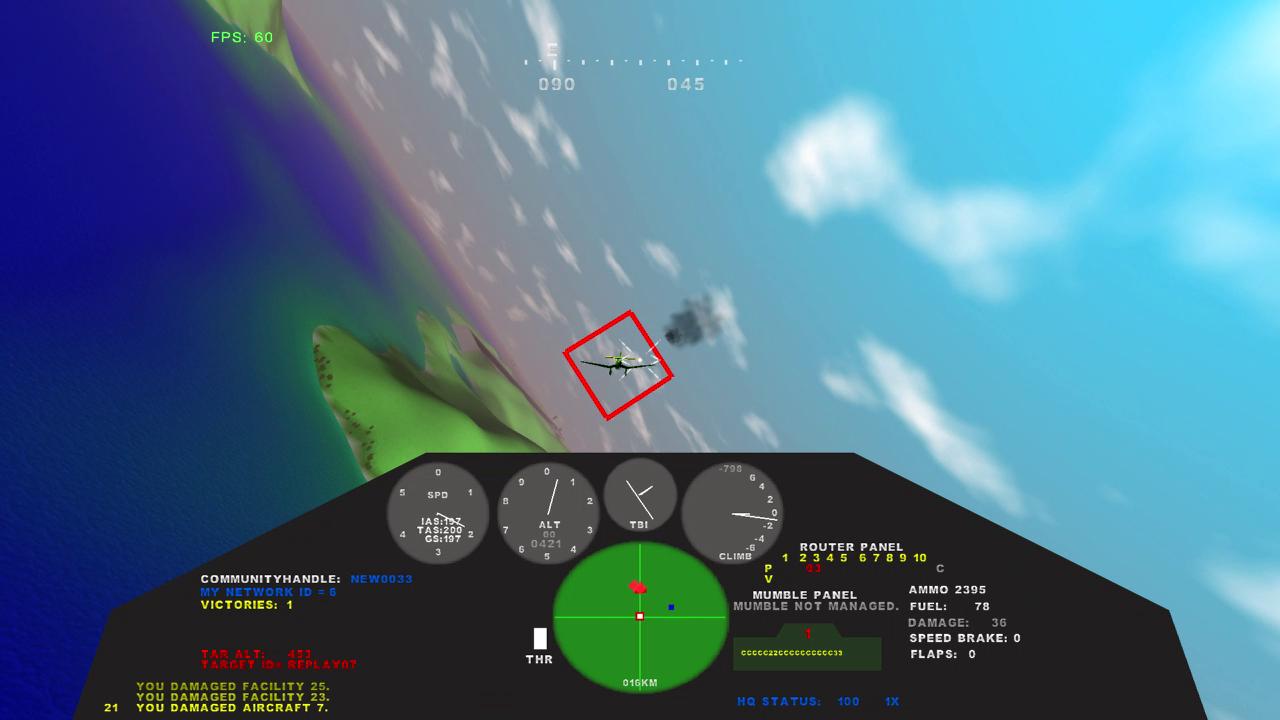
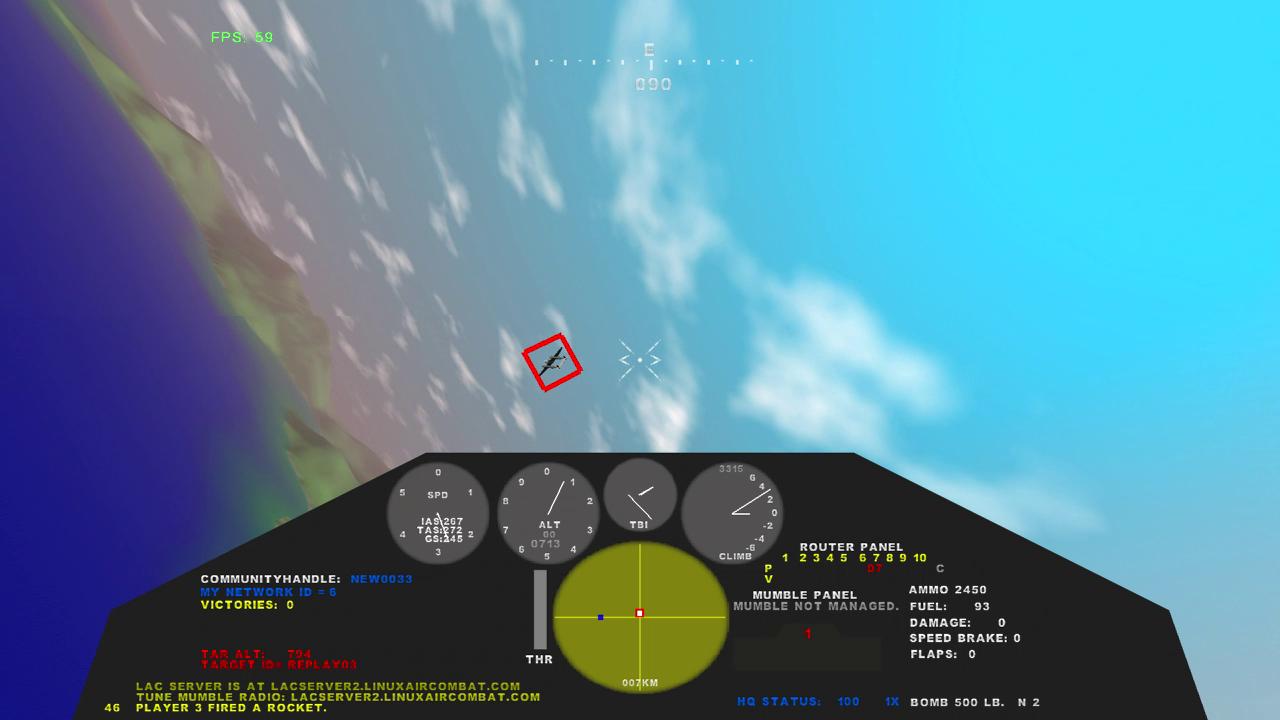
LAC's cockpit is deliberately standardized across all aircraft. The cockpit is completely standardized, so no matter what kind of airplane you choose to fly, the cockpit will look exactly the same for the selected mission. Furthermore, Linux Air Combat's instruments look more like a modern, digital glass cockpit than a World War II warbird. That choice has helped to make it easier to learn LAC than other sims that move instruments around to match each simulated aircraft. It also contributes to LAC's remarkably high frame rate and the silky-smooth sensation of flight. This is a deliberate trade-off. Purists looking for historically authentic cockpit artwork will be disappointed, but the unified design dramatically lowers the learning curve and keeps performance high.
Menus and Navigation
LAC offers two independent approaches to its menu system. There are two independent menu systems: a built-in GUI menu, and an external, text-based LacMenuLauncher for maximum compatibility with diverse Linux distros. The LacMenuLauncher was created because, on some modern desktop Linux platforms, LAC's menu buttons do not respond to mouse clicks — a known compatibility quirk that the developers have openly acknowledged and addressed.
The mission menus allow the player to choose a Realm and Team in which they want to fly the associated mission, and to select among available starting points on the associated mission map. A list of active Sentient Players and any active Replay Blokes currently using the network in the selected Realm and Mission is displayed, making it much easier for new players to find the most active missions and/or to locate participating friends.
Target Tracking and Identification
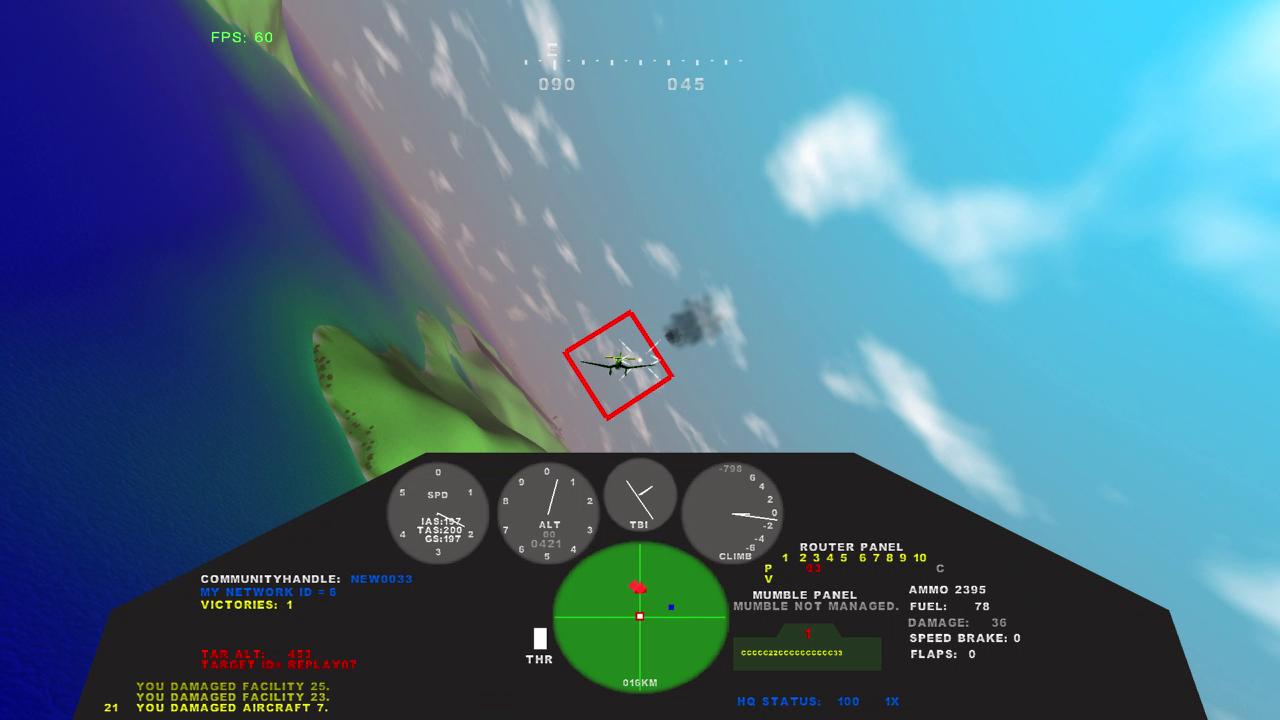
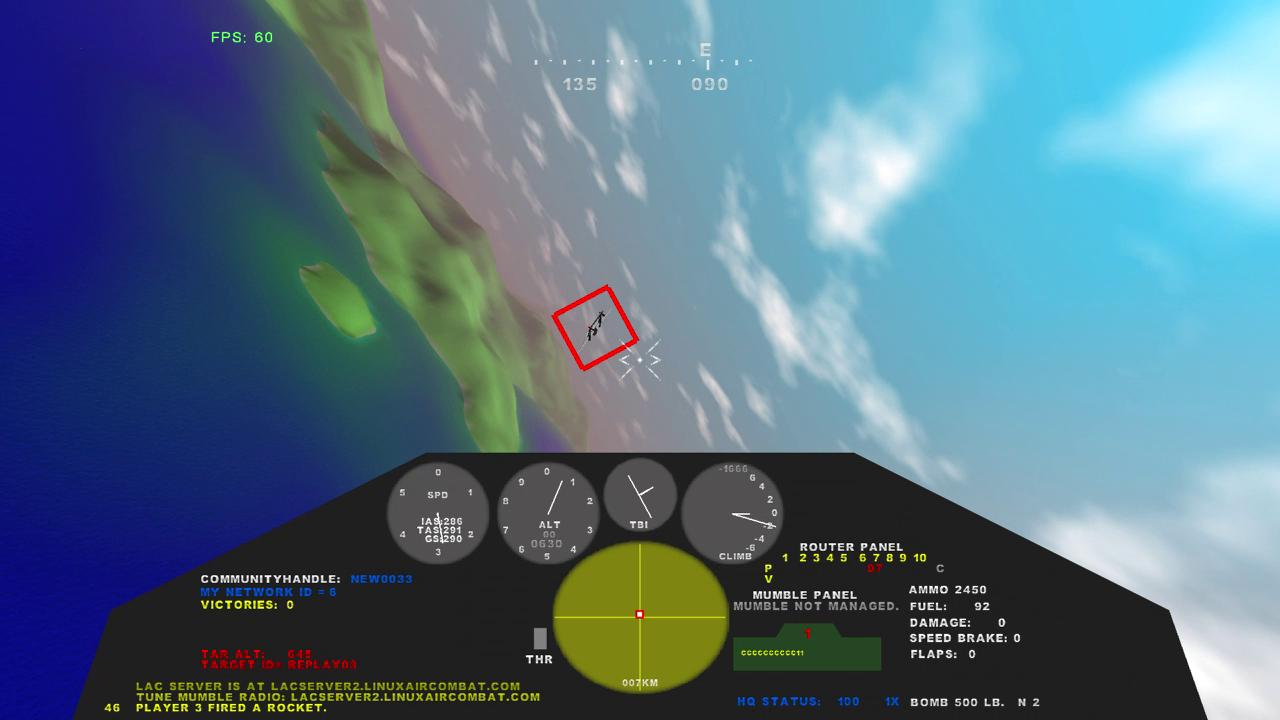
The situational awareness tools are well-developed. The RADAR display can be zoomed, and RADAR dots representing other players are color-coded by team affiliation. The current target is highlighted with a bright white center. Simulated RADAR helps locate opponents, and simulated IFF helps Identify Friend versus Foe.
The cockpit's "Talking Cockpit" feature is a practical touch: it can verbalize target location so you can hear it without diverting your eyes. When damage levels exceed about 40%, it becomes increasingly difficult for players to keep their aircraft in the air as various types of equipment fail. In addition to RADAR and target designation failures, players might expect trouble climbing or accelerating due to engine damage, trouble rolling or turning due to aileron or elevator damage, and trouble extending flaps and landing gear.
Adaptability to Flight Control Hardware
LAC's hardware support spans a wide spectrum. Modern, multi-axis analog/digital joysticks or console-style game controllers support precision control of elevators, ailerons, rudder, throttle, etc. Mouse control of elevators, ailerons, and weapons is available for those lacking a joystick. Itch45 flight and view functions can be mapped to any detected joystick axis, button, or keyboard key. The reference joystick is the Logitech Extreme 3D Pro. LAC is also available on Valve Corporation's Steam Deck hardware, with controls mapped for that platform. It is entirely possible to fly LAC without ever needing access to a computer-styled keyboard.
For users without a dedicated throttle axis, LAC provides a smart workaround. Console game controllers generally do not have a throttle lever. LAC implements a workable compromise: if you set the "32 bit" component of NetworkMode, LAC will interpret your spring-loaded throttle axis differently — your throttle setting will increase while you push upward on your spring-loaded throttle lever and will decrease while you pull downward. It will remain unchanged when the spring pulls it to the center. Many LAC players have used this configuration option with good success.
As for dedicated throttle quadrants and rudder pedals: LAC reads standard Linux joystick axes, so any hardware recognized by the Linux kernel as a joystick device should be mappable. However, the sim is principally designed and documented around the joystick-and-keyboard paradigm, and users with complex HOTAS setups may need to invest some time in configuration.
The view system is similarly well-considered. By default, LAC is preconfigured to support the classic, industry-standard Air Warrior view system, allowing the pilot to switch instantly between views using geometrically arranged keys based on the numeric keypad. This is the same kind of view system that has been in common use by most flight sims for the past 20 years, but it can be completely reconfigured — for example, it is trivial to change it to rely on the joystick's hat switch instead.
Inter-Player Communication
Communication is one of LAC's strongest suits. Linux Air Combat's communication and network features are arguably among the very best of all online flight sims, even by today's standards. The text communication system is charmingly unique. By pressing the Caps Lock key, players toggle their keyboards between the usual flight mode and Morse Code Radio mode. When the Morse Code radio is active, printable keystroke characters are transmitted, received, and displayed one by one across a separate cockpit panel, where every player in the mission can see them. Linux Air Combat accompanies every transmitted character with the authentic beeps and tones of real Morse Code. Voice communication is handled through Mumble integration. Cockpit panels and remappable keyboard controls work in cooperation with a powerful, free Mumble server available online at LinuxAirCombat.com. The combination is remarkably powerful, making it easy to meet other LAC fans and to arrange cooperative or competitive interaction in any of the many online missions.
The LAC Mumble Server even includes dynamic, web-based tutorial help focused on each of its rich set of channels dedicated to support, mission teamwork, or just chatting with other flight sim fans. That online, Mumble-based help will even display a convenient map of LAC's keyboard, numeric keypad, and joystick controls for reference during missions.
The Network Router Panel is another innovative touch. On the Network Router Panel, two rows of ten little light bulbs blink on and off to represent incoming telemetry or VOIP packets from the ten players that can participate in each of those missions. The server relays incoming packets from nearby participants more frequently than from distant participants. A quick glance at the Network Router Panel can reveal the number of active mission participants, as well as their relative distance from the player, because the lights corresponding with nearby participants will blink much faster than distant ones.
When any player begins to speak on the simulated inter-player voice radio, his corresponding Voice light bulb illuminates.
Mission Variety: Tactical and Strategic Elements
LAC offers considerably more mission depth than its modest footprint might suggest. LAC features online, two-player head-to-head missions suitable for air racing or combat duels, as well as online multiuser missions in Desert, Mountain, or Pacific Island terrains. Strategic airfield combat is available, and fighters can combat other fighters, escort friendly bombers, attack enemy bombers, or strafe enemy airfields, ships, and buildings. Bombers can rain destruction upon enemy airfields or dive-bomb ships and facilities, but they must first survive the trip to and through enemy territory.
Real-time, automated radio and RADAR warnings alert players when their airfields are threatened by strategic bombers. Realistic bomb-run tactics make heavy bombers vulnerable to opposing fighters during critical mission segments.
The Realm system provides 32 distinct online environments. Damage inflicted on enemy facilities — and repairs to your own facility — are preserved after you leave, so your effects on the ongoing tactical situation are seen by the next players to join the same mission. This gives LAC a meaningful strategic persistence that many free simulators lack entirely.
Graphics and Sound: Adequacy vs. Immersion
Here LAC's reviewers consistently acknowledge the elephant in the room and then explain why it matters less than expected. The graphics are somewhat dated by today's standards, but they are certainly adequate to inspire a feeling of real flight for anybody willing to exercise normal imagination, and the feeling of flight is unusually smooth. The silky frame rate — a direct consequence of the streamlined graphics — ironically contributes to immersion in a way that a heavier, more beautiful but slower simulator cannot match.
Fun Factor: Online Multiplayer Reputation
Community feedback on LAC's online fun factor is consistently warm, if measured. LAC is unquestionably the best Linux native air combat simulator out there. If your interests lie in WWII aircraft and WWII air combat experiences, you will love LAC. One long-time community member who had initially found the graphics and gunnery challenging noted that after three years of play, they were finally getting the hang of it, and that all the WWII planes available really fly the way they did during that war.
The SourceForge-published review ("Lac977Review.pdf") concludes: it's not perfect, and it's not the best in any one area, but it's better than average at everything that counts. It's fun, well documented, and easy to learn. In particular, because its emphasis is on historic simulation more than on gaming, LAC is far more realistic than the game console toys that are popular with teens and young adults, but it is almost as easy to learn because there is no need to memorize magic spells or game-specific, whimsical, imaginary features: it's all just science and history.
The community is described universally as small but friendly. Support from the developer is first rate, and the community of flyers growing around LAC are friendly and helpful to new pilots.
Flying Online: Sentient Players vs. Replay Blokes
This is perhaps the most distinctive aspect of the LAC online experience, and it requires careful explanation.
LAC's online community is small, which means that during many flying sessions — especially outside peak hours — no other human players will be online. The developers have built an elegant system to address this, populating missions with recorded flights called "Replay Blokes."
Sentient players are live, human players flying with you or against you in real time. You can use your Morse Code Radio or your Mumble voice radio to speak with other Sentients, and you can expect them to respond. All Sentient players can see and shoot at one another during missions. If you select a Sentient player as your current target, your cockpit's TARGET ID indicator will display the player's configured CommunityHandle.
Replay Blokes were Sentients in a prior mission that was recorded and that LAC's server has decided to replay just to keep activities interesting. They will not respond to your Morse Code or Mumble messages. Sentient players can shoot at and destroy Replay Blokes, and although the Blokes may shoot back, they will not change their pre-recorded course to avoid their antagonists. If you select a Bloke as your current target, your cockpit's TARGET ID indicator will display something beginning with REPLAY, like REPLAY08.
The system is surprisingly capable. Within Realm 1, the LAC Server automatically hosts the best of these special, pre-recorded Server Missions, in which fleets of bombers attack opposing airfields. Sometimes these bombers are opposed by interceptors. Sometimes the interceptors are shot down by bomber escort fighters.
These pre-recorded missions provide an intense, persistent experience even if no other human players are active, since the pre-recorded aircraft fly formations that were actually flown by skilled human players, according to devious and dangerous strategies.
Second-generation replay logic has been developed: suppose a Replay Mission in which one bomber bloke damages an enemy airfield every time his flight is replayed. Then suppose that in a second-generation replay mission, a different bloke in a fighter is recorded shooting that bomber bloke down before he drops his bombs. These layered, competing recorded missions create a dynamic, unscripted feel even when no live humans are present.
When Sentient players do appear, the experience shifts dramatically. When flying among these Replay aircraft, you never know when a real, live, human or Sentient player is going to join. It is becoming commonplace for users to experience a mixture of Replay and Sentient mission participants. If you find that you are the only player in an online arena, the other nine player positions are automatically staffed by bots managed by your own aircraft. As soon as another Sentient online player enters your arena, all of the bots will simply climb away into the distance in order to help you focus on human opponents.
In practical terms: hours populated by Sentient players bring unpredictability, voice radio chatter, tactical coordination, and the kind of genuine tension that only a human adversary can generate. Hours with only Replay Blokes are quieter and more formulaic — the Blokes fly their recorded routes regardless of what you do — but they are by no means empty or boring, especially in Realm 1 where the server curates the richest and most complex recorded missions.
Realm 1's Peabody's Mission, Network Battle 02, and Network Battle 03 are the most popular, and because they are almost always populated with sophisticated, diverse Replay Blokes, they are very rewarding even if no other players join in.
The developers recommend that players in this small community concentrate their activity: while the LAC community is small, everybody is encouraged to restrict their normal activities to Realm 01 to make it easier for everyone to find one another.
Documentation and Instructional Resources
LAC is unusually well-documented for a free, open-source project. LAC is extensively documented on YouTube. The primary documentation hub is the AskMisterWizard.com website, which hosts the main LAC page at askmisterwizard.com/2019/LinuxAirCombat/LacOnlineDocs.htm.
Through that link you can examine each aircraft one-by-one from pages organized alphabetically by country, manufacturer, and aircraft name. Each plane gets its own page with a tabular summary and at least two YouTube documentary video clips. These pages are also available within LAC itself, as if you were in a warbirds museum where you can study and choose among all of the displayed aircraft, then open the cockpit of your favorite, climb in, taxi out onto the runway, and fly it solo, against offline opponents, or online with others.
The Mumble integration adds a live documentation layer: the LAC Mumble Server includes dynamic, web-based tutorial help focused on each of its rich set of channels, and that online help will even display a convenient map of LAC's keyboard, numeric keypad, and joystick controls for reference during missions.
Final Assessment
Linux Air Combat occupies a unique and largely uncontested niche. For Linux users interested in WWII air combat simulation, it is simply the best free option available, and it competes credibly with classic commercial titles from the genre's golden age. Its flight model is genuinely sophisticated, its communication infrastructure is innovative, and its Replay Bloke system is a clever engineering solution to the perpetual small-community problem. The graphics and sound are honest limitations, but they are minimized by the unusually smooth sensation of flight that the efficient engine delivers.
Overall, LAC's features compare favorably with Windows-based flight sims from the genre's classic period, like Combat Flight Simulator 2, Air Warrior III, Aces High I, or Warbirds. For anyone willing to invest a modest amount of learning time and who carries a genuine enthusiasm for WWII aviation history, LAC rewards that investment with a deeply satisfying simulation experience — free of charge, on virtually any Linux hardware you happen to own.
Download
Click download now to get access to the following files:
Development log
- Linux Air Combat online Development LogFeb 23, 2022
- Linux Air Combat V8.44 Devlog (Mar2021)Nov 28, 2021
- Linux Air Combat V8.48 Devlog (Nov2021)Jan 01, 2021
- Linux Air Combat Version 7.92 released Oct2019Nov 15, 2019
- Linux Air Combat Version 7.90 released Oct2019Oct 25, 2019
- New LAC Version 7.65 published Jul2019Jul 25, 2019
- New LAC Version 5.67 uploaded late Feb 2018Feb 21, 2018



Leave a comment
Log in with itch.io to leave a comment.